What a gloriously wild and stirring sound the bells make as they ring out over the town. Ringers from around the world often visit the tower and all comment on the fine sound and their enjoyment in ringing these bells. Over hundreds of years the bells have rung out for weddings, funerals, services of all kinds and to mark the significant events of history.
St. Peter’s must have had bells from early times. In a will, dated 1376 there is reference to hanging the great bell in St. Peter’s Chapel. This reference may relate to a previous building but there is a small chance that it gives an indication of the date of construction of the present tower.

From 1457 bequests were made towards the founding of new bells and certainly three of the present bells date from about 1470. These three historic bells were made by Kebyll of London and here is the eighth bell, called John, which is one of the three.
In 1553 a return tells of there being five bells in the tower, although this is something of a mystery as the additional two bells are not found in the tower today. It is possible that they ‘migrated’ to another tower. By the nineteenth century the number of bells had risen to six, with additions in 1605, 1641 and 1662.
Perhaps the most well known escapade related to the bells took place in March 1863, when the Rector, Canon Molyneux, forbade the customary peal of bells in honour of the marriage of the Prince of Wales. He did this as he did not approve of weddings taking place in Lent. The Sexton, overhearing mutterings from the ringers, locked the tower and gave the key, for safe keeping, into the hands of the Rector. The ringing team had other ideas and, borrowing ladders, during the night reached the church roof and made their way into the ringing room by the roof door. At 5 a.m. the inhabitants of the town were woken by a merry peal of bells and the ringers remained in the tower all day, ringing many changes, to the delight, we are told, of many Sudburians, who filled the baskets, let down from the tower, with provisions.
The second half of the nineteenth century was a period of intense activity in St. Peter’s and, as part of that activity, in 1874 a further two bells were cast bringing the ring to an octave. This, again, poses something of a mystery because by 1887 the bells were almost unringable because of the poor state of the bell frame.
A plaque in the tower records that a new ringing frame for the bells was made of fine English oak by a firm of local engineers, owned by Mr. F. Barton. This followed a collection organised by Mr. G. W. Andrewes, one of the churchwardens at the time. This frame was designed to accommodate ten bells and the bells were first rung from it on Ascension Day 1887. Two plaques in the tower record major ringing achievements from this period. Mr. Charles Sillitoe was responsible for conducting both, the first on Monday 21st November, 1887 and the second on Monday January 19th 1891.
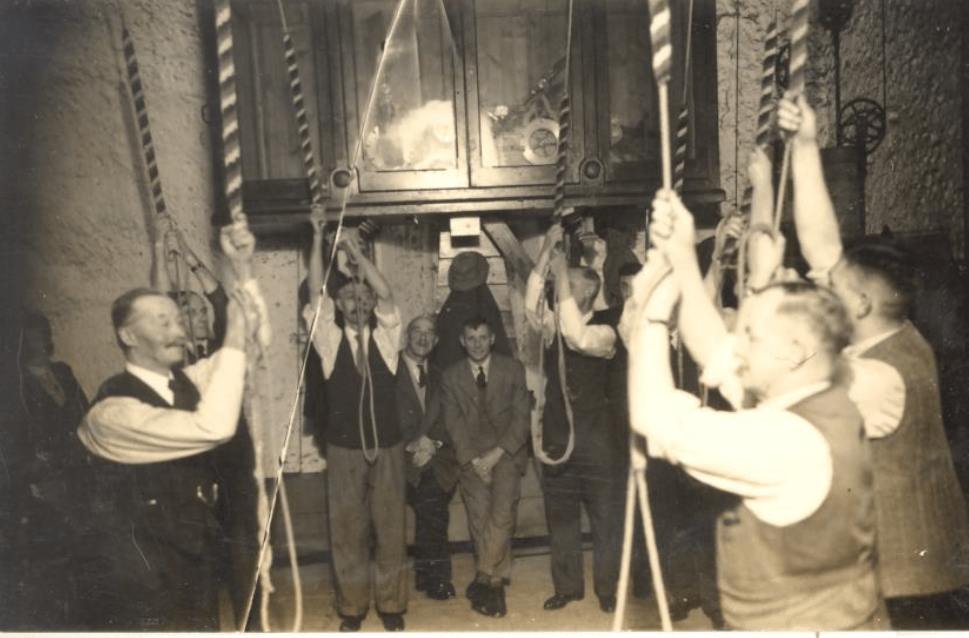
The mid twentieth century witnessed a decline in fortunes. In 1954 the tower, after standing proud in the centre of the town for nearly four hundred years, was deemed to be unsafe and bell ringing was stopped. Here we see bellringers sometime in the 20th century.
In 1968 the tower was further declared dangerous and the copper steeple was removed from the top. The tower itself was reinforced by the introduction of two massive concrete beams. The bells were taken down and hung stationary on steel girders. The bell frame was removed and lost (local legend has it that the timber was used in the renovation of the Bull Hotel in Long Melford).
It was in this sorry condition that the Friends of St. Peter found the bells, at their formation, in 1975/1976. It was one of the earliest and most pressing concerns, raised by Mr. Leslie Mills of Bures at the first public meeting which set up the Friends, that the tower bells be restored to their former glory. Leslie, a fine Suffolk gentleman, campanologist and leading light in the Suffolk Guild of Ringers, was charged with the task of setting about this restoration. Much to his credit, he achieved his goal, with the aid of a small sub- committee comprising Mr. and Mrs. Ray Playford and Mr. Peter Taylor. They spearheaded the raising of considerable funds from local business and industry (Philip Lait and Co. Ltd. was a major sponsor), as well as from an auction of paintings given by local artists. Our tower owes Leslie Mills a great debt of gratitude.
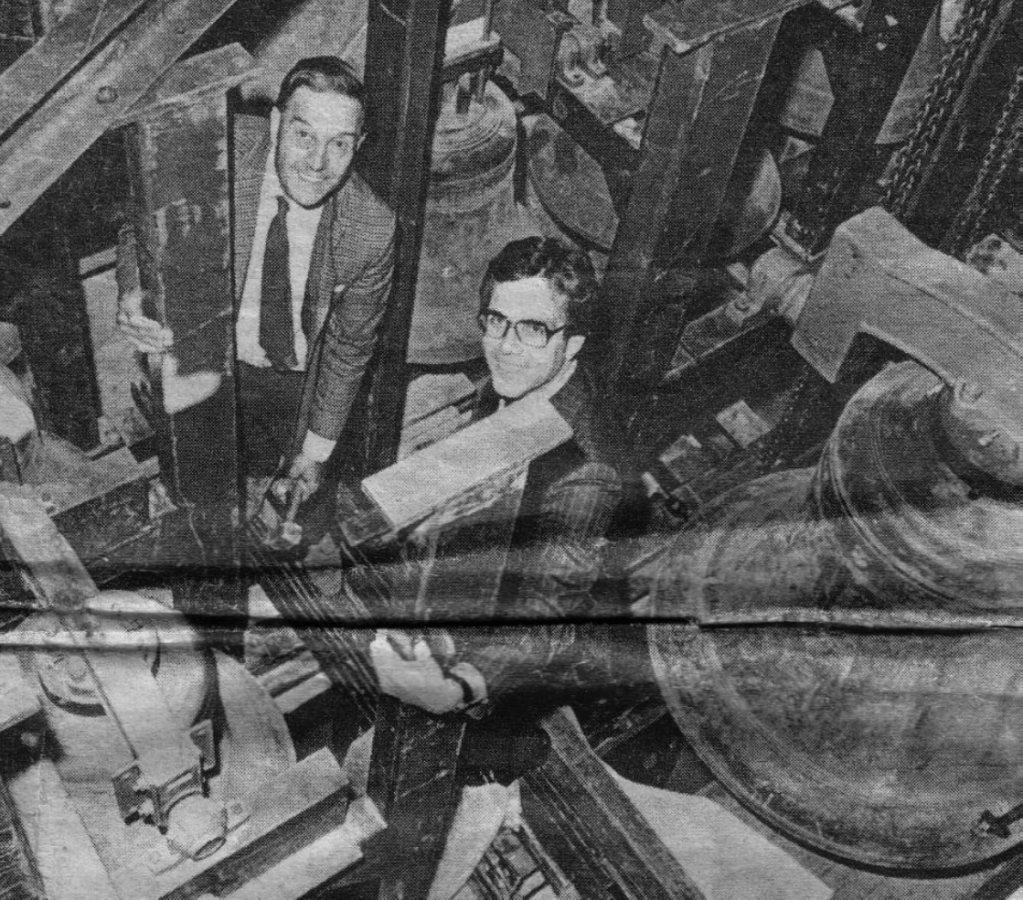
In 1978 the old bells were transported to the Whitechapel Bell Foundry for tuning and a further two bells were cast to complete a ring of ten, planned a century earlier.
The two new bells, cast on 28th June were named the Jubilee Bell and the Gainsborough Bell.
Representatives of the Friends of St Peter’s attended the casting and the unforgettable sight and sound of pouring molten metal. The now ten bells were then hung for full-circle-ringing in a new frame.
Dedication of the bells took place at a memorable service on Sunday, 8th October, 1978. The service was followed in the evening by a concert of music given by scholars from King’s College Cambridge.
In the twenty-first century the bells regularly continue a six hundred year tradition in ringing out over the town and, in so doing, mark one of the finest achievements of the Friends of St. Peter’s, Sudbury. They are maintained under the watchful eye of the Suffolk Guild of Ringers.
Roger Green
January 2024
Details of the Bells
Treble: weighs 5cwt. 18lb and sounds G#
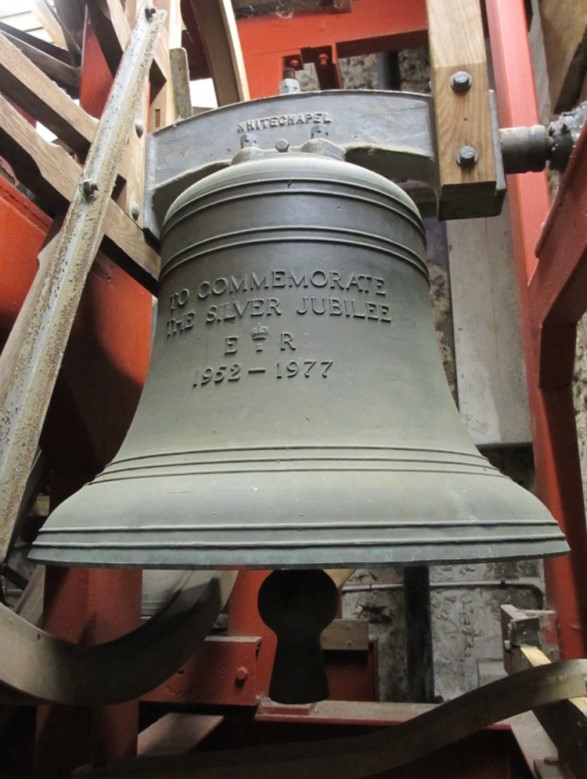
Made in Whitechapel Bell Foundry, London, 1978. Inscribed with a Royal Cypher “To commemorate the Silver Jubilee EIIR 1952 – 1977. Provided by Peter Arthur Taylor in memory of his mother Clara Ann Taylor 1897 – 1959”.
Second Bell: weighs 5cwt. 1qtr. 9lb and sounds F#
Made in Whitechapel Bell Foundry, London, 1978. Inscribed with: “The gift of East Anglian Artists commemorating Thomas Gainsborough’s 250th anniversary 1727 – 1977”.
Third Bell: weighs 4cwt. 3qtr. 26lb and sounds E
Made by John Warner and Sons, London, 1874.
Fourth Bell: weighs 5cwt. 24lb and sounds D#
Made by John Warner and Sons, London, 1874.
Fifth Bell: weighs 5 cwt. 3qtr. 8lb and sounds C#
Made by John Darbie, Ipswich. “John Darbie made me 1662”.
Sixth Bell: weighs 6 cwt. 2qtr. 23lb and sounds B
Made by James Edbury, Bury St. Edmunds, 1605. Inscribed with: “James Edburie 1605 R.B. I.S. R.S. I.W. R.F. R.B. T.B. R.B. W.B. I.C. E.C.”.
Seventh Bell: weighs 8 cwt. 3qtr. 16lb and sounds A
Made by Kebyll of London c. 1470. Inscribed with: “Sit Nomen Domini Benedictum”, Blessed be the name of the Lord.
Eighth Bell: weighs 12cwt. 25lb and sounds G#
Made by Kebyll of London c. 1470. Inscribed with: “In multis annis refonet campana Johannis”, May John’s bell sound for many years.
Ninth Bell: weighs 14cwt. 1 qtr. 25lb and sounds F#
Made by Miles Graye of Colchester 1641. Inscribed with: “Miles Gray made me 1641”
Tenor Bell: weighs 20 cwt. 1qtr. 20lb and sounds E
Made by Kebyll of London c. 1470. Inscribed with: “Intonat e celis vox campane Michaelis”, The voice of the Michael’s bell thunders from Heaven.
The Clock bell measured 24” and weighted 3 cwt. It was made by T. Mears II of London in 1831. This bell was used with the clock, the third to grace the tower and dating from 1874, although its mechanism, by Messrs. Gillet and Bland of Croydon, is now driven electrically. The bell was unhung in 1958.
Extract from the Service of Thanksgiving and Dedication, 1978.
“To the Suffolk Guild of Ringers is committed the care of these bells, now dedicated to God ……and may the bells be used to uplift the spirits of all who come within their sound.”
 The Friends of St Peter's