The Church of St. Peter, standing proud on the Market Hill in the town centre, dates from the fourteenth/fifteenth century. The stained glass that we can see today is, however, not ancient. It dates from the period of William Butterfield’s great redecoration of the church in the second half of the nineteenth century and is largely the work of Messrs. Hardman of Birmingham. The glass, often acting as a memorial, was designed to beautify and inspire the worship of the day.
In 1855 Rev. Canon John W. H. Molyneux arrived in the town. Among other things he was an Irish Baronet. He was also a highly controversial figure, a prominent member of the Tractarian movement.

That allegiance sparked a situation in which much of the town was divided between those who supported the reforms of the tractarian movement and those who supported the evangelical tradition. Vociferous sermons were preached at All Saints by Rev. Charles Badham, proclaiming against popish influence. Several prominent members of the Oxford Movement visited and preached in St. Peter’s including Rev. John Keble. Even in 1847, before the arrival of the Canon, modifications to the east window were under way.
These modifications were necessitated by Butterfield’s design for a new high altar with reredos (not the present one, which was designed fifty years later by G. F. Bodley). The east window above the altar reredos was thus the first of the present windows to be made and this was accomplished between 1856 and 1857. It depicts Christ in majesty with the four evangelists above the transom, while below is shown the Nativity and the four prophets.
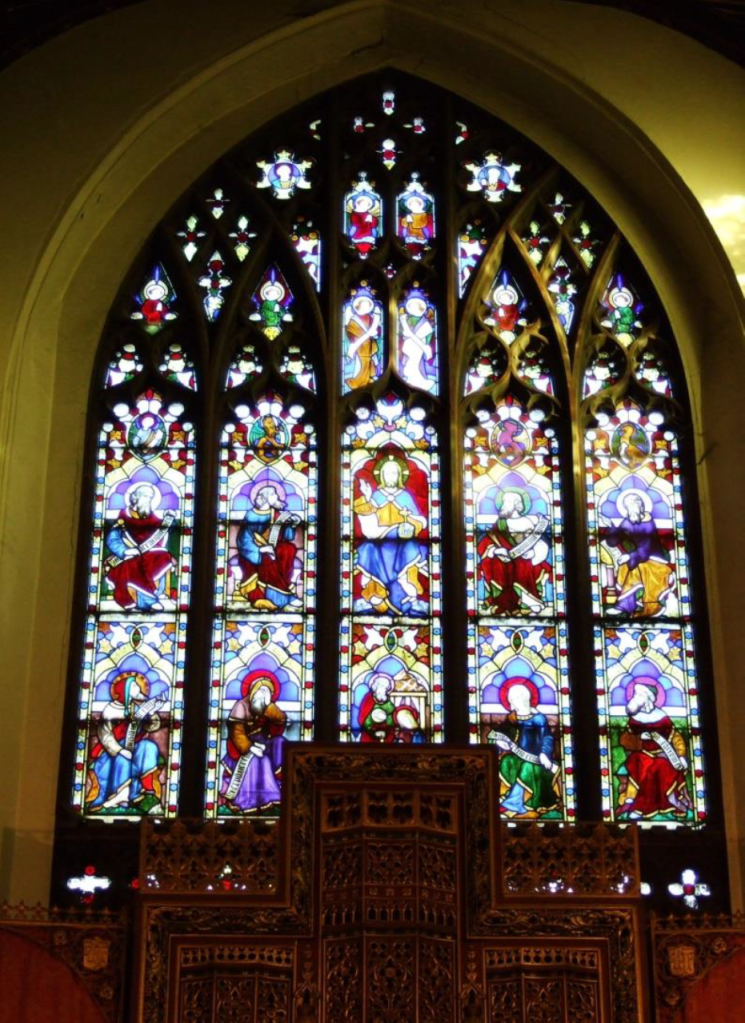
Butterfield criticised the new east window and Hardmans may have made some alterations as a result. Some today have voiced a criticism of this window as being rather static in design, in effect a series of small portraits.
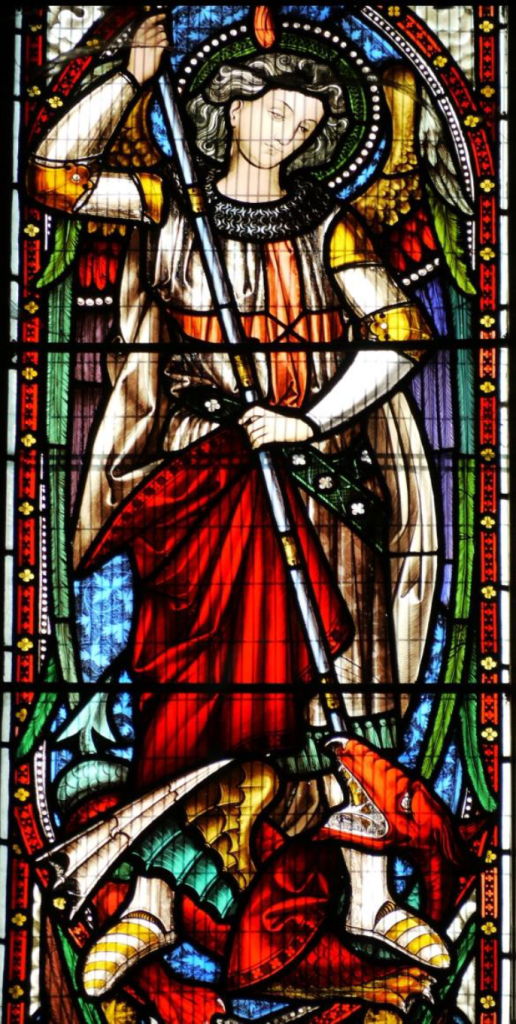
The same cannot be said of the west window, which has a wonderful sense of swirl and flow. This window dates from 1862. It portrays St. Raphael, St. Michael and St. Gabriel together with the choirs of angels.
The picture here is of St Michael.
Extending from the South Chapel is a series of windows connected to the Andrewes family, notable in the life of the town and church. The east window of this chapel offers us St. Mary Magdalene, St. Gabriel, the Blessed Virgin and St. Elizabeth above scenes from the early life of Christ, the circumcision, the presentation, Christ teaching the doctors, and his baptism. This window was given in memory of Helen Anne, 5th daughter of Charles and Elizabeth Andrewes. She was born at Berne in Switzerland on May 13th 1836 and died there on September 1st 1852. The window was put in place in 1856.
Following round the chapel, the next window offers us the transfiguration. It was erected in 1885 and dedicated to the memory of George Alfred Marshall, Major and his three children; Philip Ernest, Edward Gardiner and Mary Louisa. Also to Frank Ernest, son of the above, accidentally drowned in Peddar Bay, B.C.
The remaining chapel window depicts the visit of the Magi and was erected between 1873 and 1882. Remembered in this window are more of the Andrewes family. The left panel is a memorial to Lieut.-Col. Charles Andrewes who died 1st April 1870, the centre panel to William Ambrose who died 12th September 1874, and the right hand panel to Elizabeth Anne, wife of Charles Andrewes who died 26th November, 1857.

In the south aisle the Andrewes connection continues with the window depicting St. Peter and St. John, the three Marys and two angels at the sepulchre. This window is dedicated to the memory of George William Andrewes who was born on July 29th, 1803 and died on October 10th 1894. He was, for 47 years, Rector’s Warden. The window was erected by his children in 1896.
Further down the aisle one of the non-stained windows bears the enigmatic date of December 7th, 1901. The date refers to the re-glazing of the window by the widow of Joseph George, landlord of the Rose and Crown Inn which stood opposite this window. Joseph George was a famed local wicket keeper and batsman, scoring many centuries.

In the north aisle the memorial window to the aforementioned Canon Molyneux and his wife (erected in 1880) shows the last supper, an apt choice of subject given the Molyneux’s Tractarian leanings.
Missed by most who visit the church, because it is hidden behind the organ, is a depiction of the agony in the garden. It was erected in 1869 with the inscription, ‘Hoc posuerunt amici ad gloriam Dei, in memoriam I.L.M. et H.S.M., December 29th 1868’. ILM was John Molyneux’s daughter Isabella Louisa and HSM was his son Henry Smart.
There are five stained glass clerestory windows in the Chancel. The sixth, the most north-easterly of the windows, is blocked up but the outline is still clear from outside the building. The panels of these windows depict angels playing musical instruments. The organ, harp, lute, violin, cymbals and trumpet form part of this angelic band as do two lyres, one to the south with 6 strings and another to the north with seven strings.

The larger window in the clerestory depicts St. George with the motto “Now is come Salvation and strength and the kingdom of our God and the power of his Christ”. These windows may be the work of Burlison and Grylls.
In 1882 Rev. T. Lingard Green invited Messrs. Hardman to prepare a scheme of subjects for the remainder of the windows. This they duly did, with an appropriate emphasis on the life and work of St. Peter. To the south there were to be windows showing Christ calling the Apostles, the Ascension with St. Peter in a prominent position, St. Peter and St. Paul healing the man in the temple, St. Peter rescued from prison by the angel and St. Peter’s martyrdom. To the north there were to be windows on the subjects of the calling of St. Peter and St. Andrew, the miraculous catch of fish, Christ walking on the ocean with St. Peter sinking, St. Peter confessing Jesus to be the Christ, the entry into Jerusalem with the apostles and St. Peter prominent and finally the crucifixion. Several of these windows would have been hidden behind the organ, even though the instrument then in the building was smaller than the one that we know today.
The huge scheme was never turned into reality. In 1897 the chancel and sanctuary were decorated by G. F. Bodley in the darkest of greens and reds, highlighted with sparkling gold. If this had been accompanied by complete staining of all the windows we can, perhaps, conjure the resulting wonderfully mysterious and dimly-lit scene. Alas it was not to be!
As the splendidly grandiose scheme failed, a rather more prosaic, but effective line was adopted in the memorial window in the north west corner of the church. It celebrates peace in the South African War in 1902. Jamieson, of the famous Jamieson Raid, lived at Greyfriars, Friars Street. This window also contains one of the best versions of the Sudbury Borough Coat of Arms, granted in 1576 and including the distinctive Sudbury Talbot, derived from the coat of arms of the college instituted in the town by Simon of Sudbury, Archbishop of Canterbury.
Sadly, over the years some of the windows have ‘sagged’ and in 1999 the glass of the east window in the Lady Chapel was completely removed, much of the stone work was repaired and replaced and the glass was returned after cleaning. This major undertaking was funded by the Churches Conservation Trust. Similarly, the ‘Magi’ window in the south chapel was removed for renovation as part of the major Regeneration Project in the building, 2021 – 2023.
Roger Green
January 2024
 The Friends of St Peter's