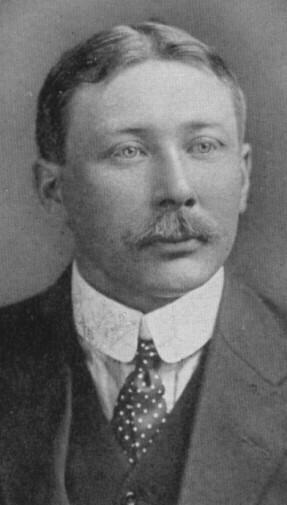
Many and various were the stories told about Edward Ellis Vinnicombe by those in the town who still remembered him with great affection and huge respect. He was a man who influenced the musical life of Sudbury for a considerable period of time. The fine organ in St. Peter’s was very much his inspiration and the essence of his spirit and soul seems to linger in the forthright voice of that wonderful instrument.
Edward Ellis Vinnicombe was born in Exeter on 14th September 1874. He must have had music running through his veins. Thomas Horne Vinnicombe, a great uncle was an organist. Great Aunt Phoebe had married the Exeter organ-builder Henry Philip Dicker and Aunt Maria was a pianist who certainly achieved local popularity.
Grandfather, John Pewtner Vinnicombe II (b. 1807) was an organist who trained in piano manufacture at Clementi’s London factory and then moved to Exeter, whence the Vinnicombes had originated, and started the family business as music sellers and tuners at Northernhay Place, Exeter.
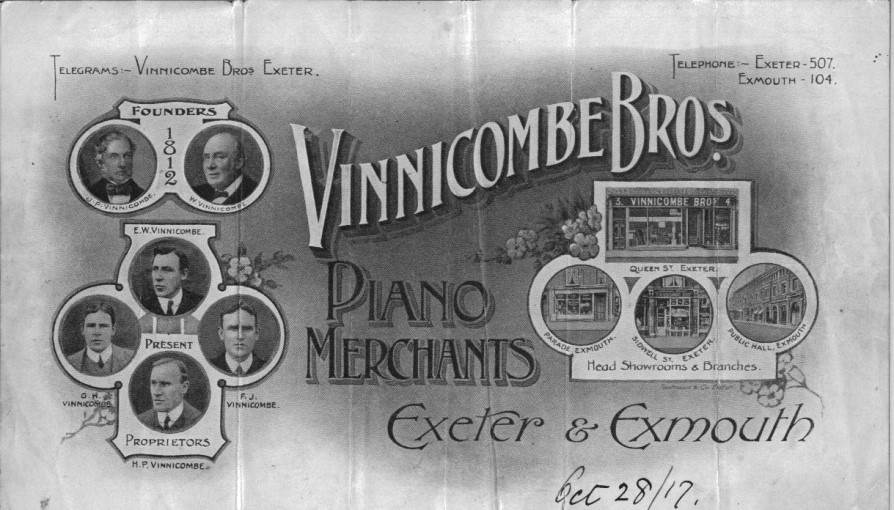
Edward Moxhay Vinnicombe (b. 1848) father of Edward Ellis was born in Exeter. He too was an able organist, at St Michael’s, Mount Dinham. He taught music and acted as one of the assistant organists at the cathedral as well as being involved in the family music business.
With such an abundance of musicians it seems the fate of Edward Ellis was sealed. He was educated at the Cathedral School in Exeter. At a meeting on 18 July 1885, the Chapter “ordered that Edward Ellis Vinnicombe be installed chorister in the place of Walter J.R. Dennis”. In 1891 he became an articled apprentice to Dr. Daniel Joseph Wood, Organist at the Cathedral. The Indenture paper, which was not drawn up until well into the apprenticeship, states that Edward Ellis is “to learn the art of Organist and the science of Music and to serve…. as an apprentice”. Daniel Wood was enjoined to “instruct him…to the best of his ability in the art of playing the Organ and the Pianoforte and in the science of harmony and counterpoint and generally prepare (him)…for the Musical Profession”. The apprenticeship was to run for four years at a cost of £15 paid annually, four lessons were to be given each week in term time.
The apprenticeship seems to have terminated early as, in 1893, the young Edward became organist at Chagford Parish Church, where his own relative H. P. Dicker had installed an organ in 1854. He remained at Chagford until 1901 and must have been happy there for years later in Sudbury he named his house at 55 Acton Lane after the village. He became an Associate of the Royal College of Organists in 1898 and gained a fellowship in 1900. It is not clear who prepared him for those examinations. Vinnicombe came to Sudbury as Organist at St. Peter’s in November 1901. Why he moved across the country and to a post with, at the time, an instrument inferior to that at Chagford, is perhaps a matter for conjecture.
The musical tradition at St. Peter’s was certainly very strong. For most of his time there, a choir of thirty men and boys sang Evensong daily.
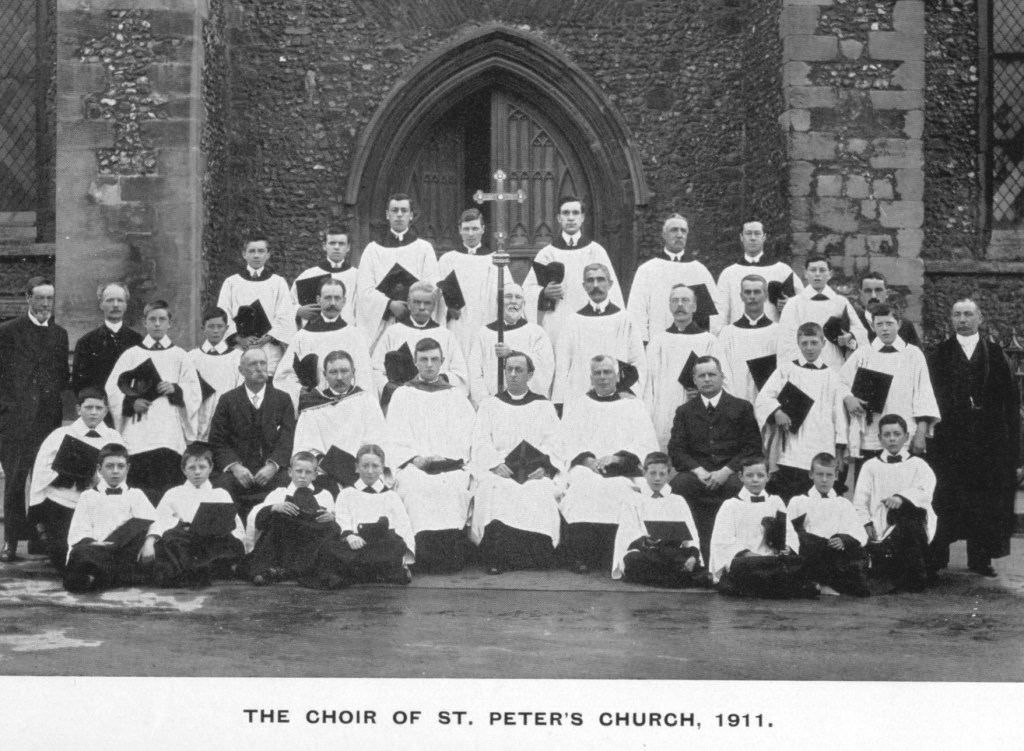
The musical portions of the services were impressive in standard and repertoire and Mr. Vinnicombe was certainly a fine organist. It is a tribute to his skills that local rumour has it that he was offered a post as Organist at Lichfield Cathedral and turned it down.
In 1908 a meeting was called, largely at Mr. Vinnicombe’s behest, to consider the provision of a new organ in St. Peter’s and it is this instrument, built by Lewis and Co. in 1911 that is so closely associated with Mr. Vinnicombe who remained as organist at St. Peter’s for close to 50 years.
During this time he kept the organ very much in his charge, although he worked with a team of assistants, perhaps the most notable of whom was Thomas Elliston. Elliston, a local man, was the author of ‘Organs and Tuning’, a respected standard text. Mr Vinnicombe gave benefit Organ Recitals on Wednesdays. A pupil in 1916 at Mrs. Simkin’s School in Melford Road can remember being given the task, each Friday, of copying out the programme for the recital to be given after Evensong the following week. Mr. Vinnicombe was noted particularly for his performances of “Finlandia” and “The Storm” by Lemmens. These he played, by request at many of his recitals, although for a while he was prevented from performing “The Storm” by the church authorities who claimed that it set up too high a level of vibration in the building.
Mr. Vinnicombe revived Sudbury Choral Society, then called Sudbury Musical Society, in 1902 and became the conductor. He was also conductor of the Frinton Musical Society and Clare and Cavendish Choral Societies grew from his activities.

Mr. Vinnicombe taught at Miss Garrad’s School in Friars Street, then called Sudbury High School for Little Boys and Girls. His nickname there was “Levine”. He was appointed to Sudbury Grammar School in May 1902 and left 18th December 1947. His duties were “lessons in pianoforte playing and instruction in class singing”. His nickname at the Grammar School was “Vinni” and indeed this title seems to have stuck to him and been used widely in the town. Many pupils at the Grammar School speak warmly of their respect for Vinni. At the same time they relate many incidents in his teaching career. In one, infuriated by a recalcitrant pupil, Vinni grabbed the boy by the shoulders and swung him round several times, releasing him to exit rapidly through the swing doors. Pupils remember his singing lessons with affection, citing their favourite songs, still alive in their memories.
Vinny would travel by train to Frinton to teach at Hill Crest and Connaught House Schools and he would walk out and back to the Rectory at Maplestead to teach singing to the Stringer girls. He also gave private lessons at home on the piano and voice, and in St. Peter’s on the organ. One pupil remembers him disappearing down the church, only to shout when things went wrong. Piano pupils speak of his complaints that pupils with sticky fingers would wreck his piano keys. Some also remember a little black ruler that was used as an incentive to progress!
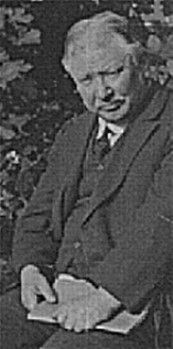
Mr. Vinnicombe, at his prime, was somewhat portly of stature, although short in height and with a somewhat waddling walk. At Frinton he was reported to have needed two school chairs to sit on! A choirboy is reputed to have wrapped a threepenny piece in an advert for “Antipon”, which was a slimming pill of the day, and put it into the recital collection box. He was a strict disciplinarian with the choir and would walk up and down listening to individual voices.
His boys remember his slightly gruff voice. In contrast, in old age, he is described as a looking like a “little white-bearded gnome”. In later years, sadly, he also became blind.
Many speak of Mr. Vinnicombe’s generosity, recounting frequent acts of kindness. Between 1939 and 1945 he acted as organist at both St. Peter’s and St. Gregory’s. During those years he saved the second wage and gave it to the organist at St. Gregory’s on his return after the war. Many again speak of Mr. Vinnicombe’s kindly sense of humour.
In the late 1920s some remember him as a lonely man who, sadly, turned to drink. Many are the tales that he left services during the sermon in order to visit one of the local hostelries. By contrast, one chorister whose father kept the Four Swans remembers Mr. Vinnicombe repairing thence after services for a piece of Stilton and a half pint of ale. This he took in the foyer of the hotel, not in the bar. It is a matter of record that Mr. Vinnicombe left St. Peter’s for a brief period in the late twenties/early thirties. He seems to have suffered some sort of breakdown. During this time he played the fine Willis organ at the Great Chapel in Friars Street (no longer in existence although the organ now stands in Ipswich School). Here he met and married Dora Brooke to whom many ascribe his recovery. His eventual reinstatement at St. Peter’s was probably with support of the minister at the chapel.
Dora had a lovely singing voice. She outlived her husband by many years reaching 100 on 31st March 1989. Two years earlier she had attended the recital in St. Peter’s, given by Christopher Dearnley, organist of St. Paul’s Cathedral, welcoming the organ back into life. She pronounced that she was ”quite overcome to hear the instrument so beloved by my husband once more in working order”.
Mr. Vinnicombe composed many Hymn Tunes. Most famed was his setting for “We love the place, Oh God”, from which he later wrote an anthem to the same theme. He also wrote many Psalm Tunes. His setting of the Nunc Dimittis was well loved. His most famous composition for the organ was “The Lonely Mere”. Another favourite was “A Sabbath Meditation – by the Stour”. His “Little Passacaglia” still survives as does his fine anthem, “Rejoice in the Lord, Oh ye Righteous” which was composed for the dedication of the organ, and based on a tune by W. Inglis Mason, a friend.
As Ed. Ellis Vinnicombe he wrote many popular songs, collaborating with C. P. Leggett, sometime Choirmaster at St. Peter’s and make-up artist for Sudbury Dramatic Society, who was invariably his lyricist.
After a full and varied musical career life Mr. Vinnicombe retired in 1946 from the organ console at St. Peter’s. He was succeeded by Harold Wiffen who had himself been a pupil. Mr. Vinnicombe was 81 when he died on Tuesday June 12th, 1956 at home. He was cremated in Ipswich on Friday June 15th at 3.00. p.m. A memorial Service was held in St. Peters on Wednesday June 20th. His own tune to the Nunc Dimittis was sung at the Service, which took the form of a shortened Evensong. Rev. F. C. Turrell, curate at the time, took the service and Mr. Clare Deeks played the organ. The Hymns sung were “Praise my Soul” and “Our Day of Praise is Done”. The concluding voluntary was “Solemn Melody” by Walford Davies. After his death a memorial Hymn Book, inscribed, was placed on the organ console of St. Peter’s. A memorial brass hangs close by. With his passing a whole musical chapter in the life of this Suffolk town closed. He was truly a musical inspiration to many and in many ways. He was certainly a legend in his own lifetime and an influence on many. I remember receiving a manuscript of one of his works. I took it to St Peter’s and put it on the organ music stand, the very spot where he would have composed it. It took a few moments before I tried to play it.
Roger Green
January 2024
 The Friends of St Peter's